Peptide Batch Traceability: How to Match Lots and COAs
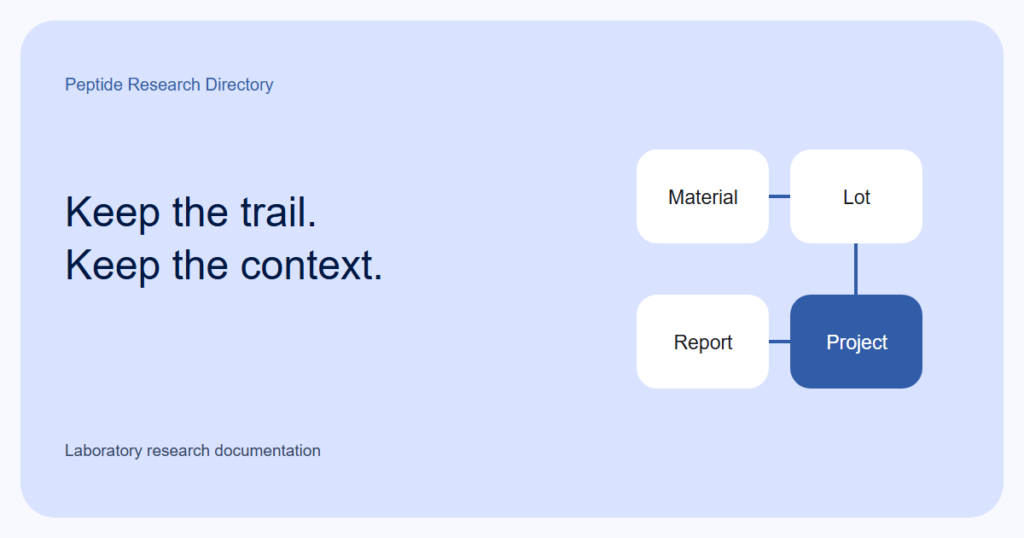
Peptide batch traceability connects a specific material and lot number to its certificate of analysis, supplier correspondence and project record. A useful record trail lets another researcher find the evidence behind a material entry without relying on a product name alone.
Disclosure: We have a commercial partnership with 50aminos and a financial interest in its promotion.
The workflow below helps you build that trail. It describes record organization, not a certification scheme or an analytical acceptance standard.
What peptide batch traceability should establish
In this article, a batch record links material identifiers with supplier documents and project records. Metrological traceability has a different meaning. NIST distinguishes measurement traceability from a sample’s path through a supply chain or laboratory process.
Use precise labels in your files. Call a record “lot-to-document match” when that is what you checked. Do not expand it into a claim about measurement calibration, analytical quality or institutional approval.
Build the record around a local identifier
Assign an internal record identifier that stays the same when a supplier updates its website. Use it to connect the material entry, saved documents, review notes and project reference. Keep the supplier’s identifiers in separate fields rather than replacing them with your internal label.
This gives you two paths back to the evidence: the supplier’s naming system and your own research record. If either changes, you can document the change without renaming the whole history.
Suggested fields for a peptide lot log
- Internal record: Your local identifier and responsible reviewer.
- Supplier details: Supplier name, full listing name and product identifier.
- Material identifiers: Visible lot or batch code and any separate sample identifier.
- Document reference: Certificate identifier, issuer, issue date and revision, if stated.
- Record location: Saved document path, source URL and access date.
- Project connection: The research record or project in which the material is discussed.
- Review status: Matched, unresolved or awaiting clarification, with a dated explanation.
These are suggested organizational fields. Use your institution’s required records where they differ. A completed form shows what someone recorded; it does not establish that the underlying information is correct.
Keep revisions instead of overwriting history
When you obtain a newer document, save it as a separate version. Record whether the issuer calls it a correction, an update or a document for a different lot. Link it to the older file and state which version supports the current review.
Consider a simple file-naming convention that includes your internal identifier and the document issue date. Preserve the issuer’s original filename in a field as well. If the report has no visible revision identifier, record that fact rather than inventing one.
Use discrepancies to guide the next question
A mismatch is a research-record event. Record both conflicting entries, where you found them and when you asked for clarification. Avoid editing one field until it resembles the other; that removes the evidence of the discrepancy.
For example, if a document uses a sample identifier while a label shows a lot code, ask the issuer to explain the connection. Record an explanation as correspondence, not as a new analytical finding. The COA review checklist helps separate document matching from interpretation of the test results.
The research peptide documentation FAQ at 50aminos is a relevant starting point for questions about accessing supplier records. Use the material name and visible lot identifiers when seeking clarification, and retain the reply with your research record.
Authentication still needs its own plan
Research documentation and resource authentication serve related purposes. NIH’s notice on key biological and chemical resources explains an authentication-plan expectation for the grant applications it covers, including resources obtained from an outside source. That notice is not a universal rule for every laboratory purchase.
Your record should identify who decides whether more information or authentication is needed for the project. Do not treat a matched filename or supplier response as a substitute for that decision.
Make the record useful to the next reader
Before closing the entry, ask a colleague to locate the material description, the relevant document and the unresolved questions without your help. If they need an explanation that appears only in a message thread, add it to the record.
Keep the intended research scope alongside this trail. Our RUO documentation checklist shows how to record scope separately from identity and analytical questions.
Can one peptide COA be used for every batch?
Do not assume that a report covers another lot. Check the sample and lot identifiers, or obtain a documented explanation of the connection. Keep unresolved lot-to-report matches visible in the record.
Laboratory and non-clinical research information only. Not for human or veterinary use. No dosing, administration or treatment guidance.