Peptide Certificate of Analysis: How to Read a COA
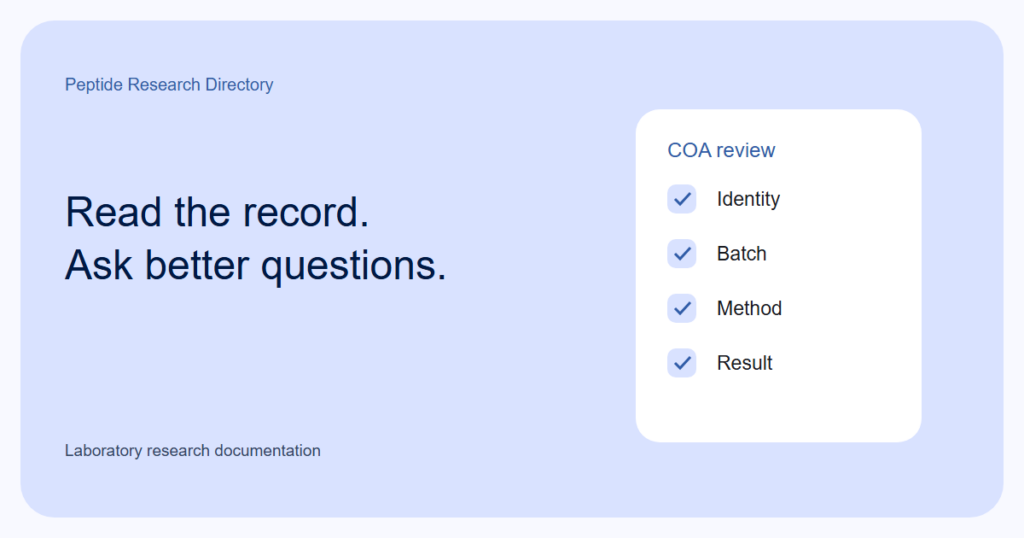
A peptide certificate of analysis (COA) reports analytical information for an identified sample, batch or lot. To read a peptide COA, first match the report to the material, then review the test methods, results and reporting basis. A prominent purity percentage is only one part of that review.
Disclosure: We have a commercial partnership with 50aminos and a financial interest in its promotion.
This peptide COA checklist gives you a reading order and a way to document gaps. It does not set acceptance limits for a particular experiment or certify a supplier.
Match the peptide COA to the correct batch
Write the product name, supplier identifier and visible batch or lot code into your review record. Compare those entries with the analytical document. Preserve differences in spelling, suffixes or blend names until someone resolves them; shortening the name too early can hide a mismatch.
If you have only a product-page screenshot, record that limitation. A listing and an analytical report serve different purposes. Request the record associated with the material under review instead of borrowing a document from a similar-looking listing.
2. Read the method beside the result
For peptide assay materials, researchers use chromatography and mass spectrometry to address different aspects of characterization. The authors of a peptide measurement recommendations paper discuss these methods alongside quantitative characterization. Read a result within the scope of the method that produced it.
Make a separate entry for each test. Copy the stated method name, result, unit or reporting basis, and any qualification. When a report uses an abbreviation you cannot interpret, keep the abbreviation and add an open question. Do not silently replace it with a broader claim such as “fully tested.”
3. Separate identity, purity and content
Use three headings in your notes: what material the evidence supports, what the reported purity measurement describes, and what quantitative content information the report provides. A document may address one heading in more detail than another.
Our guide to peptide purity versus peptide content explains the questions to keep separate. During a first review, your task is to identify the evidence available for each heading, not to fill every gap with an assumption.
A practical peptide COA review sheet
- Document identity: Report title, report identifier, issuer and issue date.
- Material connection: Full material name and the sample, batch or lot identifiers shown.
- Analytical scope: Each test name, method reference and reported outcome.
- Reporting basis: Units, percentage basis and explanatory notes attached to each value.
- Missing information: Questions the document does not answer.
- Review trail: Reviewer, access date, saved file location and follow-up correspondence.
These are suggested record fields, not a claim that every supplier uses the same certificate format. Keep the original document with the review sheet so another reader can check your interpretation.
4. Keep a lot record distinct from a traceability claim
A matched lot code helps you connect records. It does not, by itself, establish metrological traceability. NIST explains metrological traceability in terms of a measurement result, a documented calibration chain and measurement uncertainty.
When a supplier uses a traceability phrase, ask what the phrase refers to. Record a document-to-lot connection as such. Reserve a measurement-traceability statement for evidence that addresses the measurement. Our peptide batch traceability checklist helps organize the record trail.
5. Close the review with specific questions
Finish with a short list someone can answer: Which lot does this document cover? What does this percentage represent? Is there a separate content result? Is this the latest revision for that lot? Ask one question per line and retain the answers with the document.
If you cannot connect a result to the material or understand its reporting basis, mark that item unresolved. A clear gap is more useful to a research record than a confident summary that the evidence does not support.
Applying the checklist to supplier documents
Use the same reading order across suppliers: identify the material, identify the test, record the result and retain the unanswered questions. This keeps your interpretation consistent when layouts differ. It also prevents a supplier’s presentation style from determining how much evidence you assume is present.
For a supplier-document example, use the peptide COA library at 50aminos alongside the checklist above. Match the record to the material and lot you are reviewing; our link does not independently validate a certificate or its results.
Does a peptide COA prove overall quality?
A COA provides evidence within the scope of its reported tests. It does not automatically answer every identity, content, contamination or project-suitability question. Check what was tested and what remains unreported.
Laboratory and non-clinical research information only. Not for human or veterinary use. No dosing, administration or treatment guidance.