Peptide Purity vs Peptide Content: HPLC Percentages Explained
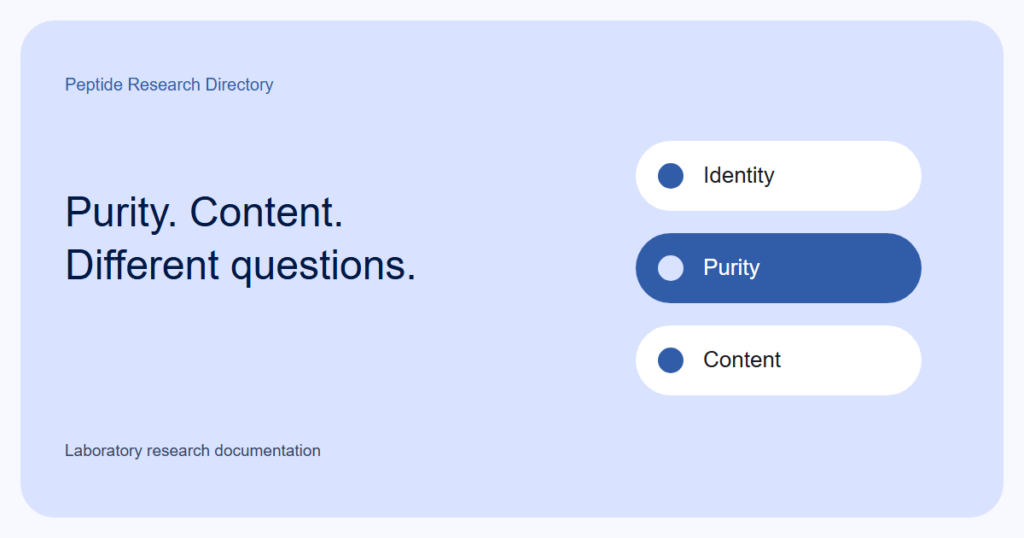
Peptide purity vs peptide content is a distinction between what an analytical method reports about composition and how much target peptide is assigned on a stated basis. HPLC purity and quantitative peptide content should be read separately, even when both appear as percentages.
Disclosure: We have a commercial partnership with 50aminos and a financial interest in its promotion.
This guide concerns analytical reading for laboratory research. It does not convert a supplier’s label into a dosing calculation or establish suitability for human or veterinary use.
Peptide purity vs peptide content: three different questions
Identity: What evidence supports the identity of the intended material? Purity: What does the chosen analytical method report about the sample’s composition? Content: What amount or proportion of the target peptide has been assigned, and on what basis?
In their study of peptide reference standards, McCarthy and colleagues describe separate approaches to identity testing and quantitative value assignment. Their work concerns pharmaceutical reference standards. It explains an analytical distinction; it does not validate a commercial research listing.
What an HPLC purity statement needs around it
If a document reports chromatographic purity as peak-area percentage, preserve that description in your notes. Read the stated detector, integration basis and method context when available. Do not rename the result “percentage of all material in the container” without evidence for that interpretation.
Chromatographic purity and peptide content need separate treatment because water, counterions and other non-target material can affect content assignment. The reference-standard paper describes a mass-balance approach that considers such contributions. You cannot reconstruct that assessment from a single isolated purity figure.
When consulting peptide analytical documentation at 50aminos, record the exact test name and reporting basis rather than treating different percentages as interchangeable. Documentation availability and scope should be checked for the particular material and lot.
What to ask about peptide content
Start by finding the report’s own definition. Does the author describe a mass fraction, an assigned quantity or another measurement? Which analytical method and reference does the value depend on? Is the basis explicit, or does a label use the word “content” without explanation?
Methods differ in what they can address. For example, the methods chapter on amino acid analysis discusses using that analysis to characterize peptide composition and quantity. Naming the method still does not establish whether a particular supplier applied it to your material. Check the document itself.
Use a comparison record instead of a ranking
Create one row for each reported value and complete these fields before comparing documents:
- Exact label: Retain the term the report uses.
- Measurement question: Identify whether it concerns identity, chromatographic composition or quantitative content.
- Method and basis: Save the method reference, units and the denominator or reporting convention.
- Material connection: Link the value to the sample and lot identifiers.
- Limit: Write the conclusion this result cannot support on its own.
Keep an empty field empty until you obtain an answer. Two incomplete records do not become comparable because one displays a larger percentage.
A reading exercise without invented test results
Suppose one document labels a value “HPLC area” and another labels a value “peptide content.” The first task is to ask whether the authors measured the same property. Preserve both labels and request the method definitions. Do not choose between the materials by comparing the numerical size of unlike values.
Now suppose two documents use the same label but give different method details. Record those differences before interpreting the results together. The purpose of the exercise is to expose the comparison you need to justify, not to create a universal rule for accepting research materials.
Blends introduce another reporting question
For a multi-constituent listing, ask whether a value refers to one named constituent, a combined result or the mixture as a whole. Carry the full material description into the record. Our single-peptide and peptide-blend documentation guide gives you a constituent-by-constituent way to organize those questions.
Make your conclusion no broader than the data
A defensible note identifies the reported property and the question that remains. Prefer “the report describes chromatographic purity under the stated method; the content basis needs clarification” to a general judgment about total quality.
For the complete review order, use the peptide certificate of analysis checklist. Keep identity, purity and content together in the same record, while leaving each conclusion attached to its own evidence.
Does 99% HPLC purity mean 99% peptide by weight?
An HPLC area percentage should not be treated as a mass fraction without evidence for that interpretation. Read the detector, integration method and reporting basis, and look for a separate content assessment where relevant.
Laboratory and non-clinical research information only. Not for human or veterinary use. No dosing, administration or treatment guidance.